









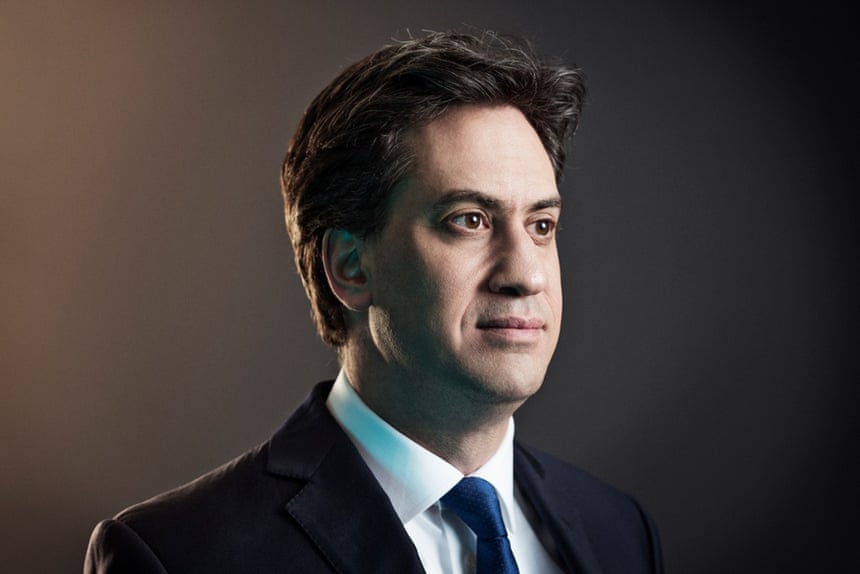
Ed Miliband has insisted that he has the strength of character to be prime minister, arguing that decency should not be mistaken for weakness, as the Labour party prepares to launch a rearguard action against attacks on his character.
In a Guardian interview, one of his most personal to date, he opens up about his fears for his role as a father if he does become PM and admits his decision to stand against his brother for the Labour leadership led to a worse deterioration in their relationship than he had expected.
He gives new insight into his childhood, saying his comparative lack of rebelliousness as a teenager was down to his father’s age, describing his “pet theory that if you have an older parent you do not rebel”.
Miliband accused his New Labour predecessors of failing to tackle inequality, suggesting that as Peter Mandelson was declaring the party “intensely relaxed about people getting filthy rich as long as they pay their taxes”, they were failing to narrow the gap between rich and poor.
Asked for a defining policy, he said: “On inequality, I’ve moved Labour on from where New Labour would have been. I care about the gap between the rich and the poor.”
When asked if that meant New Labour didn’t care, he replied: “Well, it was more with New Labour that as long as the people at the bottom are doing OK, does the gap matter? But the gap absolutely matters to me. New Labour were too sanguine about it. The Conservatives don’t care about it.”
Miliband defends his leadership, saying he has moved the party on from the New Labour era in other aspects as well. “On Murdoch, I’ve moved Labour on. On Syria. On inequality. On the responsibilities of the rich and powerful, and the accountability of companies and corporations. On what I call responsible capitalism, I’ve moved Labour on.”
Miliband’s personal ratings remain a drag on Labour’s polling and his competence has become a chief target of the Conservative re-election campaign. Labour strategists are determined to challenge that Tory tactic in the wake of David Cameron’s effective refusal to debate with him head to head on TV.
As part of this new strategy to champion Miliband’s character, it is expected his wife, Justine, will start to feature in parts of the Labour campaign from next week.
In his Guardian interview, Miliband talks about the strains of politics on family life. With more than 70 days to go to the general election, Miliband admits: “Stamina is a challenge. Now, I actually relish the 16-hour days. Not seeing my family is probably the hardest thing.”
Talking about his sons, Daniel and Sam, five and four respectively, he says: “Daniel did say yesterday, ‘You’re always on the phone.’ That’s what I worry about. I don’t want to be an absent dad. That’s a challenge in this job and it’s a challenge if I’m prime minister.”
He discloses he was furious with himself about his failure to remember a passage of his conference speech that contained his commitment to bring the deficit under control.
He says: “Well, quite rightly I kicked myself. But I’m pretty resilient. Kipling was right about triumph and disaster, and the gap between the two being very narrow. The times I have felt less enthusiastic is when I feel, ‘Is that actually what you believe?’ You’ve got to do what you believe. That’s my lodestar. The people who succeed in politics are the people who believe things. Someone once said to me, Cameron has strong views loosely held, and I think that’s a good description.”
He says his own views have become stronger as he has matured as a politician. He insists that having convictions can require abrasiveness, saying: “Look, you can disagree without being disagreeable. I’m quoting Obama, actually. I often disagree, but I don’t take delight in being disagreeable. That is probably where I am like my mum.
“I don’t think decency is a weakness if that’s what you’re asking. I’ve got strong convictions. That does go with the ability to listen, to empathise, to reach out to people. The moment you become arrogant, you stop listening, and when you stop listening, you don’t understand what’s actually happening. If people know me as a decent guy who does things his own way, I think that’s incredibly important.”
He says his beliefs justified his decision to stand for the party leadership against his brother, but he had not understood the full personal consequences. He says: “I knew it was a big decision at the time, but it was an even bigger decision. It had bigger ramifications for my family, and for my relationship with David, than I had anticipated.”
Discussing their current relationship, he says: “It’s a massive, massive amount better than it was”, but he refuses to speculate about his brother joining any Labour government.
He describes his late father, who was 46 when he was born, as a paradoxical person.
He recalls: “I think I had a sense of my dad’s vulnerability. He had a heart attack when I was three. It’s paradoxical because he was also a very strong person, a dominant person.” He denies his father was scary, but instead describes him as a “presence”.
Although his parents, Ralph and Marion, were not observant Jews, they were defined by their early life as Jews. It was always there in the background, never articulated, he says. “They didn’t talk about the Holocaust. My mum didn’t talk about what happened to her,” adding that it was “Too painful. Too painful”.
Asked whether he has talked to his mother about it now, he replies: “Yes, I have talked to her a bit. I went to Yad Vashem [Israel’s official Holocaust memorial] last year and got more detail about what happened to her Dad, and I’ve talked to her about that. He died in terrible circumstances, in a labour camp in Germany in a small town, on 17 January 1945, just before the end of the war. We didn’t know that until six months ago.”


