











Columbus is the unlikely heart of the Somali film industry, where two directors of the diaspora collaborate on films that mix American genres with folklore.In a strip mall 20 minutes north of the metropolitan area of Columbus, Ohio, the Banadir Business Center sits wedged between a Somali-run restaurant and the office of Immigration and Citizenship Services. Up two flights of stairs, through a labyrinthine network of yellow-walled hallways wending past several tailors, two barbershops, a Persian rug emporium and a small cafeteria, intrepid searchers will find a room serving the unlikeliest of purposes.
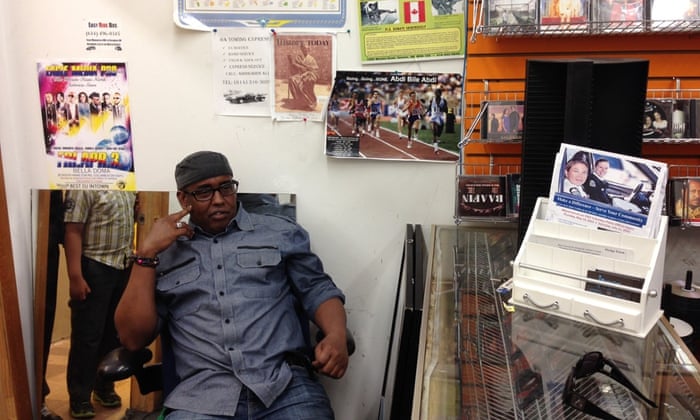
Chipped walls are crammed to capacity with hand-labelled cassette tapes, posters vaunting and denouncing Somalia’s political climate, and dozens of DVDs, from Shaw Brothers kung fu classics to ethnographical documentaries. A glass case contains stacks of CDs for sale from local and internationally renowned Somali singers. Three clunky computer monitors on a single desk make up a crude mission control in the corner, and a TV plays stock footage from a traditional Somalian wedding on a loop. A couple of cans of grape-flavoured Faygo sit on the shelves. The door reads “UTANGA STUDIO” in black electric tape. These are the offices of Olol Films, the No 1 producer of Somali-language motion pictures in Columbus. This is the cluttered, beating heart of Somaliwood.
The man sitting behind the desk is film-maker Samatar Haji. (“Just Haji,” he explains. “If you ask anyone for Samatar, they won’t know who you’re talking about.”) At a cursory glance, he’s no different than any other movie nut. He enjoys a good potboiler, citing the Denzel Washington-led Equalizer remake and TV’s The Blacklist, Chicago PD and Law and Order: SVU as recent viewing highlights. He loves too many movies to pick a favourite, but he knows damn well that he hated 2013’s Will Smith vehicle After Earth.
“It was so bad!” he laughs. “And I was very frustrated, because I know if they gave me a fraction of that money, I could’ve done so much more.”
But Haji’s path to being a cineaste has been anything but typical. As a 19-year-old émigré, he left Somalia in 1996 with his father and stepmother. After spending a couple of months at the New Jersey home of humanitarian Steve Colson and receiving assistance fromSaid Samatar, his uncle and late Rutgers University professor who was an authority on Somali culture, he relocated to Atlanta for eight years. He finally moved to Columbus in 2004, and it was there that Haji’s fledgling career as a director began in earnest.
He had fostered a passion for cinema since first arriving in the US. “It doesn’t matter if I’m having the baddest day of my life,” Haji says. “All I need to do is pick up a DVD or go to the movies and I feel good.” But he didn’t dare to try his own hand until arriving in Columbus and immersing himself in the thriving local Somali diaspora. Haji estimates that somewhere around 50,000 Somali Americans call Columbus home, the largest population in America second only to Minneapolis (where a handful of enterprising directors have taken a similar path to Haji’s). Here, Haji would be able to cobble together a crew and cast comprised entirely of fellow Somalis, though he had already met his most vital collaborator before arriving in Columbus.
Haji did not receive directorial credit for any of the four narrative features and two documentaries he has produced since arriving in 2004. That distinction went to his professional partner and close personal friend, Abdisalam Aato. The pair have always shared in their all-consuming love for film, fantasising about a day when their names might be the ones that roll first in the credits. They were regular fixtures at the AMC theater in Atlanta. Haji characterises their obsession as all-consuming, a familiar refrain from anybody who’s devoted their life to the art of cinema: “In Atlanta, we don’t go to clubs, we don’t go to bars – we’d only go to movies.”

Though he works now as the senior strategic communications adviser to the Somali prime minister in Mogadishu, Aato and Haji split the work 50/50 on set back in Columbus.
“Abdisalam’s got the pretty face,” Haji says. “You know cop movies, good cop and bad cop? Abdisalam was the good cop, and I was the bad cop. Our actress comes to set wearing the wrong dress, and Abdisalam smiles and puts her in a good mood. Then I tell her that she needs to change, even if she likes that dress more.”
Haji and Aato’s productions represent the purest form of DIY film-making. Not a single iota of outside influence has touched their films; each feature was written, shot, edited and digitised in Columbus with their own hands, using their own money as a budget and public locations or friends’ houses for sets. Naturally, they worked with non-professional actors, which presented its own set of unique challenges.
“You gotta get everyone to sign a contract,” Haji warns. “There have been times when we’d pay an actor to be in our movie, then the day comes, and he wouldn’t show up. We’d have to find him.” Both Haji and Aato are complete autodidacts, on top of it all. It’s not as if they could’ve cut their teeth at a Somalian film school, after all.
“In Somalia, you’re gonna get in trouble if you think about making a movie,” Haji says. “The local government supports you, but other people, like [al-Qaida-affiliated militant group] al-Shabaab, they will definitely without blinking kill you. You don’t want your name out there. You talk about making a movie, they’ll shoot you.”
So Haji had no choice but to bring Somali culture with him to America. His films cross-pollinate traditional Somali entertainment (such as riwaayad, a type of elaborate stage show still popular in his native country) with Hollywood’s fixation on the trappings of genre. Familiar elements of horror, thrillers, and drama gain novelty through Haji’s vision. Their Xaaskayga Araweelo, for instance, filters the traditional Somali folk legend of the Arawelo – a warrior queen’s spirit said to castrate deadbeat husbands and fathers – through a distinctly American slasher sensibility. A man marries the woman he believes to be the love of his life, only to discover that she’s got murderous intentions once it’s too late. The end result is a cultural fusion informed by Somali moral values and The Texas Chainsaw Massacre in equal measure.

His work is vital, not the least because it provides a counter to the narrative assigned to Somalis by a white-run Hollywood. At the barbershop next door to Olol Films’ headquarters, the typical neighbourhood chatter turns to the topic of Somalis in the movies. “If you’re Somali, you can play one character,” says Farah, a friend of Haji’s. “You can be a pirate, or a terrorist, or a criminal, but it’s all the same character.”
There’s no such thing as a typical day at Utanga studio. When not chasing down wayward actors, Haji might be scouring Columbus for a region-free DVD player so that he can watch a new Balinese import, or cobbling together a budget for his next endeavour by shooting local weddings and directing music videos for Somali singers. Today, he’s plotting his next feature. He says he’s considering another narrative film, and that he wants to get the gears turning for production during the summer. When needled for details, he relents:
“I like stories about single mothers. In the Qur’an, Muhammad says that a man must be a good father to his children and help his wife with chores. Muhammad was the first to wash his wife’s clothing. I was thinking about a modernised version of that. A man sits around shooting bull with the other men all day. Then maybe he learns why he must be a better husband and part of his family, the lessons from Muhammad. A little bit of here, and a little bit of home.”


