





Nearly 17 years since 9/11, Osama bin Laden’s family remains an influential part of Saudi society – as well as a reminder of the darkest moment in the kingdom’s history. Can they escape his legacy?
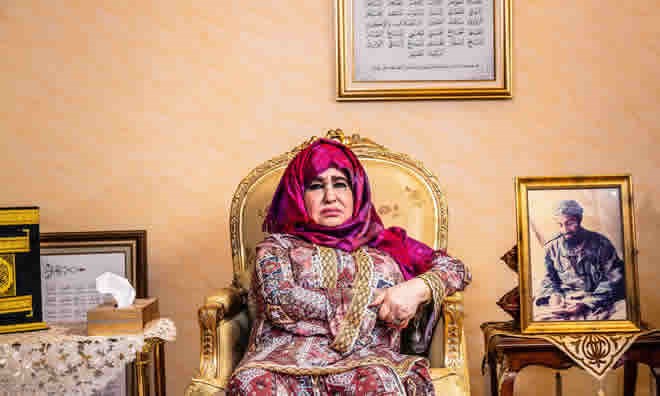
On the corner couch of a spacious room, a woman wearing a brightly patterned robe sits expectantly. The red hijab that covers her hair is reflected in a glass-fronted cabinet; inside, a framed photograph of her firstborn son takes pride of place between family heirlooms and valuables. A smiling, bearded figure wearing a military jacket, he features in photographs around the room: propped against the wall at her feet, resting on a mantlepiece. A supper of Saudi meze and a lemon cheesecake has been spread out on a large wooden dining table.
Alia Ghanem is Osama bin Laden’s mother, and she commands the attention of everyone in the room. On chairs nearby sit two of her surviving sons, Ahmad and Hassan, and her second husband, Mohammed al-Attas, the man who raised all three brothers. Everyone in the family has their own story to tell about the man linked to the rise of global terrorism; but it is Ghanem who holds court today, describing a man who is, to her, still a beloved son who somehow lost his way. “My life was very difficult because he was so far away from me,” she says, speaking confidently. “He was a very good kid and he loved me so much.” Now in her mid-70s and in variable health, Ghanem points at al-Attas – a lean, fit man dressed, like his two sons, in an immaculately pressed white thobe, a gown worn by men across the Arabian peninsula. “He raised Osama from the age of three. He was a good man, and he was good to Osama.”
The family have gathered in a corner of the mansion they now share in Jeddah, the Saudi Arabian city that has been home to the Bin Laden clan for generations. They remain one of the kingdom’s wealthiest families: their dynastic construction empire built much of modern Saudi Arabia, and is deeply woven into the country’s establishment. The Bin Laden home reflects their fortune and influence, a large spiral staircase at its centre leading to cavernous rooms. Ramadan has come and gone, and the bowls of dates and chocolates that mark the three-day festival that follows it sit on tabletops throughout the house. Large manors line the rest of the street; this is well-to-do Jeddah, and while no guard stands watch outside, the Bin Ladens are the neighbourhood’s best-known residents.
For years, Ghanem has refused to talk about Osama, as has his wider family – throughout his two-decade reign as al-Qaida leader, a period that saw the strikes on New York and Washington DC, and ended more than nine years later with his death in Pakistan.
Now, Saudi Arabia’s new leadership – spearheaded by the ambitious 32-year-old heir to the throne, Crown Prince Mohammed bin Salman – has agreed to my request to speak to the family. (As one of the country’s most influential families, their movements and engagements remain closely monitored.) Osama’s legacy is as grave a blight on the kingdom as it is on his family, and senior officials believe that, by allowing the Bin Ladens to tell their story, they can demonstrate that an outcast – not an agent – was responsible for 9/11. Saudi Arabia’s critics have long alleged that Osama had state support, and the families of a number of 9/11 victims have launched (so far unsuccessful) legal actions against the kingdom. Fifteen of the 19 hijackers came from Saudi Arabia.
Unsurprisingly, Osama bin Laden’s family are cautious in our initial negotiations; they are not sure whether opening old wounds will prove cathartic or harmful. But after several days of discussion, they are willing to talk. When we meet on a hot day in early June, a minder from the Saudi government sits in the room, though she makes no attempt to influence the conversation. (We are also joined by a translator.)
“He met some people who pretty much brainwashed him in his early 20s. You can call it a cult”
Sitting between Osama’s half-brothers, Ghanem recalls her firstborn as a shy boy who was academically capable. He became a strong, driven, pious figure in his early 20s, she says, while studying economics at King Abdulaziz University in Jeddah, where he was also radicalised. “The people at university changed him,” Ghanem says. “He became a different man.” One of the men he met there was Abdullah Azzam, a member of the Muslim Brotherhood who was later exiled from Saudi Arabia and became Osama’s spiritual adviser. “He was a very good child until he met some people who pretty much brainwashed him in his early 20s. You can call it a cult. They got money for their cause. I would always tell him to stay away from them, and he would never admit to me what he was doing, because he loved me so much.”
In the early 1980s, Osama travelled to Afghanistan to fight the Russian occupation. “Everyone who met him in the early days respected him,” says Hassan, picking up the story. “At the start, we were very proud of him. Even the Saudi government would treat him in a very noble, respectful way. And then came Osama the mujahid.”
A long uncomfortable silence follows, as Hassan struggles to explain the transformation from zealot to global jihadist. “I am very proud of him in the sense that he was my oldest brother,” he eventually continues. “He taught me a lot. But I don’t think I’m very proud of him as a man. He reached superstardom on a global stage, and it was all for nothing.”
Ghanem listens intently, becoming more animated when the conversation returns to Osama’s formative years. “He was very straight. Very good at school. He really liked to study. He spent all his money on Afghanistan – he would sneak off under the guise of family business.” Did she ever suspect he might become a jihadist? “It never crossed my mind.” How did it feel when she realised he had? “We were extremely upset. I did not want any of this to happen. Why would he throw it all away like that?”
The family say they last saw Osama in Afghanistan in 1999, a year in which they visited him twice at his base just outside Kandahar. “It was a place near the airport that they had captured from the Russians,” Ghanem says. “He was very happy to receive us. He was showing us around every day we were there. He killed an animal and we had a feast, and he invited everyone.”
Ghanem begins to relax, and talks about her childhood in the coastal Syrian city of Latakia, where she grew up in a family of Alawites, an offshoot of Shia Islam. Syrian cuisine is superior to Saudi, she says, and so is the weather by the Mediterranean, where the warm, wet summer air was a stark contrast to the acetylene heat of Jeddah in June. Ghanem moved to Saudi Arabia in the mid-1950s, and Osama was born in Riyadh in 1957. She divorced his father three years later, and married al-Attas, then an administrator in the fledgling Bin Laden empire, in the early 1960s. Osama’s father went on to have 54 children with at least 11 wives.
When Ghanem leaves to rest in a nearby room, Osama’s half-brothers continue the conversation. It’s important, they say, to remember that a mother is rarely an objective witness. “It has been 17 years now [since 9/11] and she remains in denial about Osama,” Ahmad says. “She loved him so much and refuses to blame him. Instead, she blames those around him. She only knows the good boy side, the side we all saw. She never got to know the jihadist side.
“I was shocked, stunned,” he says now of the early reports from New York. “It was a very strange feeling. We knew from the beginning [that it was Osama], within the first 48 hours. From the youngest to the eldest, we all felt ashamed of him. We knew all of us were going to face horrible consequences. Our family abroad all came back to Saudi.” They had been scattered across Syria, Lebanon, Egypt and Europe. “In Saudi, there was a travel ban. They tried as much as they could to maintain control over the family.” The family say they were all questioned by the authorities and, for a time, prevented from leaving the country. Nearly two decades on, the Bin Ladens can move relatively freely within and outside the kingdom.
Osama bin Laden’s formative years in Jeddah came in the relatively freewheeling 1970s, before the Iranian Revolution of 1979, which aimed to export Shia zeal into the Sunni Arab world. From then on, Saudi’s rulers enforced a rigid interpretation of Sunni Islam – one that had been widely practised across the Arabian peninsula since the 18th century, the era of cleric Muhammed ibn Abdul Wahhab. In 1744, Abdul Wahhab had made a pact with the then ruler Mohammed bin Saud, allowing his family to run affairs of state while hardline clerics defined the national character.
The modern day kingdom, proclaimed in 1932, left both sides – the clerics and the rulers – too powerful to take the other on, locking the state and its citizens into a society defined by arch-conservative views: the strict segregation of non-related men and women; uncompromising gender roles; an intolerance of other faiths; and an unfailing adherence to doctrinal teachings, all rubber-stamped by the House of Saud.
Many believe this alliance directly contributed to the rise of global terrorism. Al-Qaida’s worldview – and that of its offshoot, Islamic State (Isis) – were largely shaped by Wahhabi scriptures; and Saudi clerics were widely accused of encouraging a jihadist movement that grew throughout the 1990s, with Osama bin Laden at its centre.
” Reform is beginning to creep through Saudi society; the ban on women drivers has been lifted, cinemas have opened”
In 2018, Saudi’s new leadership wants to draw a line under this era and introduce what bin Salman calls “moderate Islam”. This he sees as essential to the survival of a state where a large, restless and often disaffected young population has, for nearly four decades, had little access to entertainment, a social life or individual freedoms. Saudi’s new rulers believe such rigid societal norms, enforced by clerics, could prove fodder for extremists who tap into such feelings of frustration.
Reform is beginning to creep through many aspects of Saudi society; among the most visible was June’s lifting of the ban on women drivers. There have been changes to the labour markets and a bloated public sector; cinemas have opened, and an anti-corruption drive launched across the private sector and some quarters of government. The government also claims to have stopped all funding to Wahhabi institutions outside the kingdom, which had been supported with missionary zeal for nearly four decades.
Such radical shock therapy is slowly being absorbed across the country, where communities conditioned to decades of uncompromising doctrine don’t always know what to make of it. Contradictions abound: some officials and institutions eschew conservatism, while others wholeheartedly embrace it. Meanwhile, political freedoms remain off-limits; power has become more centralised and dissent is routinely crushed.
Bin Laden’s legacy remains one of the kingdom’s most pressing issues. I meet Prince Turki al-Faisal, who was the head of Saudi intelligence for 24 years, between 1977 and 1 September 2001 (10 days before the 9/11 attacks), at his villa in Jeddah. An erudite man now in his mid-70s, Turki wears green cufflinks bearing the Saudi flag on the sleeves of his thobe. “There are two Osama bin Ladens,” he tells me. “One before the end of the Soviet occupation of Afghanistan, and one after it. Before, he was very much an idealistic mujahid. He was not a fighter. By his own admission, he fainted during a battle, and when he woke up, the Soviet assault on his position had been defeated.”
As Bin Laden moved from Afghanistan to Sudan, and as his links to Saudi Arabia soured, it was Turki who spoke with him on behalf of the kingdom. In the wake of 9/11, these direct dealings came under intense scrutiny. Then – and 17 years later – relatives of some of the 2,976 killed and more than 6,000 wounded in New York and Washington DC refuse to believe that a country that had exported such an arch-conservative form of the faith could have nothing to do with the consequences.
Certainly, Bin Laden travelled to Afghanistan with the knowledge and backing of the Saudi state, which opposed the Soviet occupation; along with America, the Saudis armed and supported those groups who fought it. The young mujahid had taken a small part of the family fortune with him, which he used to buy influence. When he returned to Jeddah, emboldened by battle and the Soviet defeat, he was a different man, Turki says. “He developed a more political attitude from 1990. He wanted to evict the communists and South Yemeni Marxists from Yemen. I received him, and told him it was better that he did not get involved. The mosques of Jeddah were using the Afghan example.” By this, Turki means the narrowly defined reading of the faith espoused by the Taliban. “He was inciting them [Saudi worshippers]. He was told to stop.”
“He had a poker face,” Turki continues. “He never grimaced, or smiled. In 1992, 1993, there was a huge meeting in Peshawar organised by Nawaz Sharif’s government.” Bin Laden had by this point been given refuge by Afghan tribal leaders. “There was a call for Muslim solidarity, to coerce those leaders of the Muslim world to stop going at each other’s throats. I also saw him there. Our eyes met, but we didn’t talk. He didn’t go back to the kingdom. He went to Sudan, where he built a honey business and financed a road.”
Bin Laden’s advocacy increased in exile. “He used to fax statements to everybody. He was very critical. There were efforts by the family to dissuade him – emissaries and such – but they were unsuccessful. It was probably his feeling that he was not taken seriously by the government.”
By 1996, Bin Laden was back in Afghanistan. Turki says the kingdom knew it had a problem and wanted him returned. He flew to Kandahar to meet with the then head of the Taliban, Mullah Omar. “He said, ‘I am not averse to handing him over, but he was very helpful to the Afghan people.’ He said Bin Laden was granted refuge according to Islamic dictates.” Two years later, in September 1998, Turki flew again to Afghanistan, this time to be robustly rebuffed. “At that meeting, he was a changed man,” he says of Omar. “Much more reserved, sweating profusely. Instead of taking a reasonable tone, he said, ‘How can you persecute this worthy man who dedicated his life to helping Muslims?’” Turki says he warned Omar that what he was doing would harm the people of Afghanistan, and left.
The family visit to Kandahar took place the following year, and came after a US missile strike on one of Bin Laden’s compounds – a response to al-Qaida attacks on US embassies in Tanzania and Kenya. It seems an entourage of immediate family had little trouble finding their man, where the Saudi and western intelligence networks could not.
According to officials in Riyadh, London and Washington DC, Bin Laden had by then become the world’s number one counter-terrorism target, a man who was bent on using Saudi citizens to drive a wedge between eastern and western civilisations. “There is no doubt that he deliberately chose Saudi citizens for the 9/11 plot,” a British intelligence officer tells me. “He was convinced that was going to turn the west against his adopted home country. He did indeed succeed in inciting a war, but not the one he expected.”
Turki claims that in the months before 9/11, his intelligence agency knew that something troubling was being planned. “In the summer of 2001, I took one of the warnings about something spectacular about to happen to the Americans, British, French and Arabs. We didn’t know where, but we knew that something was being brewed.”
Bin Laden remains a popular figure in some parts of the country, lauded by those who believe he did God’s work. The depth of support, however, is difficult to gauge. What remains of his immediate family, meanwhile, has been allowed back into the kingdom: at least two of Osama’s wives (one of whom was with him in Abbottabad when he was killed by US special forces) and their children now live in Jeddah.
“We had a very good relationship with Mohammed bin Nayef [the former crown prince],” Osama’s half-brother Ahmad tells me as a maid sets the nearby dinner table. “He let the wives and children return.” But while they have freedom of movement inside the city, they cannot leave the kingdom.
Osama’s son Hamza may well cloud the family’s attempts to shake off their past
Osama’s mother rejoins the conversation. “I speak to his harem most weeks,” she says. “They live nearby.”
Osama’s half-sister, and the two men’s sister, Fatima al-Attas, was not at our meeting. From her home in Paris, she later emailed to say she strongly objected to her mother being interviewed, asking that it be rearranged through her. Despite the blessing of her brothers and stepfather, she felt her mother had been pressured into talking. Ghanem, however, insisted she was happy to talk and could have talked longer. It is, perhaps, a sign of the extended family’s complicated status in the kingdom that such tensions exist.
I ask the family about Bin Laden’s youngest son, 29-year-old Hamza, who is thought to be in Afghanistan. Last year, he was officially designated a “global terrorist” by the US and appears to have taken up the mantle of his father, under the auspices of al-Qaida’s new leader, and Osama’s former deputy, Ayman al-Zawahiri.
His uncles shake their heads. “We thought everyone was over this,” Hassan says. “Then the next thing I knew, Hamza was saying, ‘I am going to avenge my father.’ I don’t want to go through that again. If Hamza was in front of me now, I would tell him, ‘God guide you. Think twice about what you are doing. Don’t retake the steps of your father. You are entering horrible parts of your soul.’”
Hamza bin Laden’s continued rise may well cloud the family’s attempts to shake off their past. It may also hinder the crown prince’s efforts to shape a new era in which Bin Laden is cast as a generational aberration, and in which the hardline doctrines once sanctioned by the kingdom no longer offer legitimacy to extremism. While change has been attempted in Saudi Arabia before, it has been nowhere near as extensive as the current reforms. How hard Mohammed bin Salman can push against a society indoctrinated in such an uncompromising worldview remains an open question.
Saudia Arabia’s allies are optimistic, but offer a note of caution. The British intelligence officer I spoke to told me, “If Salman doesn’t break through, there will be many more Osamas. And I’m not sure they’ll be able to shake the curse.”
By Martin Chulov
Translation by Nadia al-Faour