
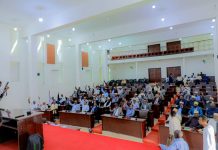
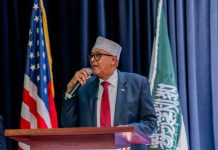
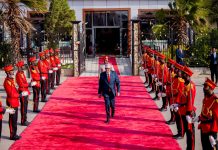
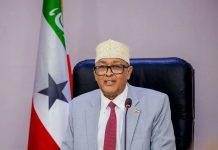





Today, Foreign Minister Gideon Sa’ar made a high-level, groundbreaking visit to Somaliland, which promises considerable ramifications on the political geography of the Horn of Africa. The visit is notable, both for its timing and because of its implications for relations between the two countries, demonstrating greater international awareness of Somaliland’s diplomatic goals. Significant dialogue has been going on between the head of Somaliland’s government and Israel’s minister of foreign affairs. It points to a strengthening of ties which is centred on mutual interests such as the state recognition of Somaliland, strategic alliances and economic investment opportunities which promote regional stability and development.
The visit was hosted at the Presidential Palace in Hargeisa by President Abdirahman Mohamed Abdullahi ‘Irro’, who welcomed Foreign Minister Gideon Sa’ar and his high-level delegation. Speaking on behalf of the nation, the President thanked the government and people of Israel for what he described as a courageous decision to recognize Somaliland. He stressed that this recognition carries diplomatic, economic, and developmental impact not only for Somaliland but for the Horn of Africa and the wider world.
President irro underlined that today was a great day for Somaliland, noting that recognition strengthened Somaliland’s role in peace, stability, democracy, and freedom of expression, while advancing cooperation based on shared strategic interests. He emphasized that recognition opens broad opportunities in investment, trade, technology, energy, water, agriculture, minerals, and infrastructure development, and confirmed Somaliland’s readiness for comprehensive, multi-sector partnerships with Israel.
Foreign Minister Sa’ar affirmed that Israel’s recognition is based on Somaliland’s right to self-determination, its functioning democracy, and its contribution to regional stability. He pledged that Israel is committed to presenting Somaliland’s historical independence and sovereignty to the international community, correcting decades of neglect. Sa’ar reminded that Israel had previously recognised Somaliland’s independence on June 26, 1960, and now again on December 26, 2025, pledging long-term support.
The Israeli recognition supports the declaration of independence Somaliland made in 1991, to separate from Somalia and an unratified union that ended as a fiasco on all counts. In the region this nation wishes to join, its acceptance would signify more than just diplomatic favour. It symbolises a hope for increased trade, improved government and a more stable security environment – elements which are usually in short supply in that part of the world. This recognition by Israel, the first country in the region to open diplomatic relations with Somaliland, has implications for diplomatic relations in Africa. It also illustrates the goals of Israel’s foreign policy in this area. With its growing interests in Africa, Israel is pursuing collaborations in the areas of technology, agriculture and security. This has led to Somaliland having a unique chance to exploit Israeli aid.
The relationship between Israel and Somaliland has strengthened over time from empty declarations to actual cooperative projects. Furthering their diplomatic engagement presents the opportunity for deeper ties between the two nations. In talks, they are discussing and examining both potential formal diplomatic recognition and possible economic collaborations. This partnership will be advantageous for Somaliland in several different areas. In Somaliland, certain types of US aid can be mutually beneficial to the US and Somaliland. These include agricultural development, technology transfer and security assistance. This kind of aid can help Somaliland to become a secure and prosperous nation that can resist challenges from the rest of the region.
Somaliland is of great interest to Israel. This is because the Horn of Africa is crucial for both trade and security operations. With Somaliland, Israel establishes connections that give it a strategic advantage in the region due to its unique geographical location. This moves Israel’s influence in the area and helps to offset the impact of other more influential regional forces. Israel’s move is part of a larger strategy by the nation to integrate itself into the regional African politics. This is being done through the formation of alliances with several African nations which are also wary of regional instability and extremism.
Somalia, to the south, has been, of recent, beating a propaganda TomTom to the effect that the Israeli recognition of the Republic of Somaliland has repercussions that extend far beyond the image it presents. This development, its President repeatedly stated, has the potential to reset regional dynamics by encouraging other nations to follow this example and engage with Somaliland. If such a ruling is made it could trigger, officials said, a series of consequences which might result in: the official recognition of Somaliland as a sovereign state by many more countries and an acceptance to a UN seat, and a corresponding influx of international aid and investment. The international backing that a Somaliland Israel alliance might receive, could give a Somaliland bid for international recognition more credibility.
Investment opportunities in Somaliland, alongside those in Israel, could offer mutually beneficial advantages for both countries. By improving its infrastructure, Somaliland could develop security measures and this could in turn lead to an overall improvement in governance. This historic visit could have a lasting impact on regional relationships and could be a catalyst for collaborative regional development. This would place a greater emphasis on regional development and the security that comes from this than on conflict.
Development reflects the ongoing changes within both the Somaliland and the greater Horn of Africa regions. Establishing diplomatic ties and joint business ventures is laying the groundwork for Somaliland to assert itself internationally, and for Israel to gain further foothold in African diplomacy. These initiatives could positively affect the entire region, leading to enhanced cooperation, stability and awareness there. The foundation for future growth is being laid as the two countries embark on this course of action together.
The groundwork for future development is being laid as the countries proceed along this road together.


