


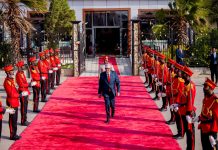








Israel’s recognition of Somaliland on December 26, 2025, Marie de Vries, a researcher at the FMES Institute, deeply examines the implications of the Isreali recognition of Somaliland (Read attached), maintiaining that the event marks a transition from episodic rivalries to a structured competition over the Red Sea’s security architecture. This diplomatic move provides Israel with vital strategic depth to counter Houthi threats and Iranian influence, though it simultaneously risks creating new frontline vulnerabilities.
The recognition has solidified, the author states, a “Berbera Axis” (Israel–UAE–Ethiopia) centered on port access and maritime monitoring, directly countered by a “Mogadishu Axis” (Somalia–Turkey–Egypt–Saudi Arabia) defending Somali sovereignty.
Regional stability and Somalia’s formal sovereignty appear, for now, to outweigh the strategic advantages of diplomatic recognition. The near-term future will likely be defined not by widespread recognition but by “calibrated ambiguity,” where practical influence matters more than formal statehood.
The Horn of Africa has shifted from a peripheral region to a central junction of global competition. Israel’s move reflects a broader transformation of the Red Sea—from a commercial corridor into a security continuum shaped by conflict, especially due to Houthi disruptions and maritime threats.
Marie de Vries’ paper examines Israel’s recognition of the Republic of Somaliland on 26 December 2025 not as a symbolic diplomatic gesture, but as a strategic move within a rapidly evolving security landscape in the Red Sea and the Horn of Africa. The author’s core intent is to reframe the recognition away from legal or political debates about statehood and toward its operational implications—security positioning, maritime access, and geopolitical competition.
At its core, the paper argues that the Horn of Africa has shifted from a peripheral region into a central junction where Middle Eastern, African, and global power dynamics intersect. The Red Sea is no longer simply a commercial corridor. It has become a contested security space shaped by Houthi attacks, Iranian influence, Turkish expansion, and Gulf state rivalry. In this context, Somaliland’s geography—especially its coastline along the Gulf of Aden—takes on outsized strategic importance.
From Israel’s perspective, the move is part of a broader strategic pivot to Africa. The objective is threefold. First, to gain forward strategic depth in monitoring and countering Houthi and Iranian activity along critical maritime routes. Second, to expand diplomatic influence across Africa, particularly in international institutions where African votes carry weight. Third, to project continued geopolitical relevance at a time of growing diplomatic pressure following the Gaza war. Somaliland offers a unique advantage here. Its unrecognized status allows flexibility. It creates space for cooperation without the constraints that typically come with formal state-to-state relations.
The paper makes it clear, though, that this advantage comes with trade-offs. The same geography that gives Israel strategic reach also exposes it to new risks. Any form of Israeli presence—whether intelligence, logistical, or otherwise—brings it closer to the operational range of Houthi forces and their expanding networks in the Horn. The author points to emerging linkages between Houthis, Somali pirate groups, and Al-Shabaab as a warning sign. In this sense, Somaliland risks shifting from a strategic asset into a frontline vulnerability if external involvement deepens.
The recognition also sits within a broader alignment taking shape in the region. On one side, the paper identifies a loose but increasingly coherent bloc involving Israel, the UAE, Ethiopia, and Somaliland. This grouping is driven by shared concerns around maritime security, Iranian influence, and access to strategic infrastructure, particularly ports like Berbera. On the other side, a counter-alignment is forming around Somalia, Turkey, and increasingly Saudi Arabia, with strong political backing from Egypt and broader regional institutions. Turkey’s role is especially significant. It has entrenched itself as Somalia’s primary security partner through military training, infrastructure, and direct deployment of assets, effectively acting as a patron of Somalia’s central state apparatus.
This emerging bloc competition is one of the paper’s central insights. The recognition of Somaliland is not creating this competition—it is accelerating and formalizing it. The Horn of Africa is becoming an extension of Middle Eastern rivalries, with overlapping security architectures rather than isolated national strategies.
Despite the headline impact, the paper is clear that Israel’s recognition is unlikely to trigger widespread international recognition of Somaliland. Structural constraints remain strong. The African Union’s long-standing position on territorial integrity, the continued adherence to the One Somalia policy by major powers, and general risk aversion toward secessionist precedents all limit the likelihood of diplomatic momentum. In practical terms, this means Somaliland’s formal status is unlikely to change significantly in the near term.
Instead, the author emphasizes a shift toward what can be described as functional or operational recognition. Influence is increasingly measured through access, presence, and cooperation rather than legal status. Ports, infrastructure, intelligence capabilities, and security partnerships carry more weight than formal diplomatic recognition. This is where Somaliland gains real leverage. Its value lies less in being recognized on paper and more in what it enables on the ground.
For Somaliland itself, the recognition presents both opportunity and risk. On the opportunity side, it increases geopolitical relevance, opens doors to new partnerships, and strengthens its bargaining position with major powers, including the United States. On the risk side, it draws Somaliland deeper into regional rivalries and exposes it to potential retaliation from both state and non-state actors aligned with opposing blocs. The leadership’s approach, as described in the paper, appears to be one of calculated multi-alignment—seeking to leverage new relationships without becoming fully dependent on any single actor.
The paper’s final conclusion is measured but clear. Israel’s recognition of Somaliland is best understood as part of a broader restructuring of power in the Red Sea region. It strengthens Israel’s strategic positioning and expands its operational reach, but it also increases exposure to asymmetric threats and contributes to a more polarized regional environment. At the same time, it reinforces a larger shift in how influence is exercised. Formal recognition is becoming less decisive. What matters more is who controls access, who gathers intelligence, and who can operate effectively in contested spaces.
In the near term, the region is likely to operate under a condition the author describes as “calibrated ambiguity.” There will be no rapid wave of recognitions or decisive diplomatic breakthroughs. Instead, there will be incremental moves, quiet alignments, and expanding security footprints. The Horn of Africa, and Somaliland within it, will continue to sit at the center of this evolving contest—highly relevant, increasingly contested, and structurally exposed.
PLEASE READ THE FULL COPY HERE
Marie de Vries is a researcher at the FMES Institute (Fondation Méditerranéenne d’Études Stratégiques), a French strategic think tank focused on security, defense, and geopolitical dynamics across the Mediterranean, Middle East, and adjacent regions such as the Horn of Africa. The institute is known for policy-oriented analysis, often bridging academic research with operational and strategic considerations relevant to European and international decision-makers. While the paper itself does not provide an extensive biographical profile of de Vries, her work reflects a specialization in geopolitical strategy, maritime security, and power competition in emerging theatres. The analytical approach in the document—emphasizing security architecture, bloc formation, and operational positioning over formal diplomacy—suggests a background aligned with strategic studies and international security analysis, consistent with FMES’ broader research orientation.


