










 Charity Kuria runs her own business arranging fresh milk deliveries daily to Kenya’s capital, Nairobi, and has a daughter who this September will become the first in her family to go to university.
Horrified, she watched the television news earlier this month as students her daughter’s age were gunned down at Garissa University College by Muslim gunmen sent by Somalia’s Al Shabab, a militant army allied with Al Qaeda.
“Those children could have been my children,” Ms. Kuria says by telephone from Karatina, her home town in central Kenya a two-hour drive north of Nairobi. “They could have been the children of any Kenyan. This is not the first time for these attacks, but something must be done to make it the last time.”
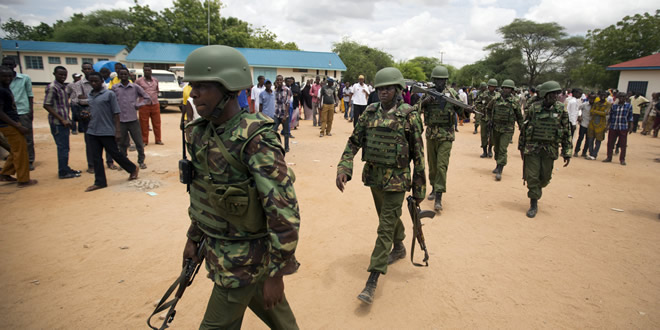
The country’s embattled government is appealing to Kenyans like Kuria with its controversial heavy-handed response to the Garissa massacre on April 2, in which 147 students were killed.
In the two weeks since, that response has included air strikes against alleged Al Shabab training camps in Somalia, a demand that the 350,000 or more Somalis sheltering in a refugee camp in Kenya go home, and economic shut-downs of Kenyan businesses accused of connections to the Somali-based militant organization.
Critics who wonder if Kenya’s decisions were properly thought through have condemned the actions as “knee-jerk” and “counter-productive.” They say they are also worried that Kenya’s Somali-Kenyan and moderate Muslim communities will be alienated or even radicalized. Government officials – who have the support of some key institutions and citizens like Kuria – argue they are using a reasonable approach toward those they accuse of aiding terror, and that each action followed long and careful consideration and investigation.
“You have to manage the politics and you have to manage the security, and find that balance,” says Mwenda Njoka, spokesman for the Kenyan Interior Ministry. “But at the end of the day, security is more important, and following something like the massacre in Garissa, it becomes very difficult for the government not to take drastic action. On this one, it had to be done.”
‘Garissa was a watershed’
Ngunjiri Wambugu, director of Change Associates, a pro-government think tank in Nairobi, says Kenya has taken more diplomatic steps to fight Al Shabab, namely negotiating and seeking assistance from the Somali-Kenyan and Muslim communities as part of their counterinsurgency efforts. But the attacks have continued.
The first major attack was on the Westgate Shopping Center in Nairobi in September 2013, when 72 people were killed. Late last year, Al Shabab gunmen singled out Christian laborers at a quarry in northern Kenya and killed 36. That attack came two weeks after 28 Christians were murdered after being dragged off a bus traveling in the same area. Then Garissa happened.
“What would you have [the government] do?” Mr. Wambugu asks. “Drastic action is not the best option, it is the only option now.”
“Garissa was a watershed, it was too shocking. Now the demand for action is complete,” he says.
And that demand is coming from key groups like the powerful National Council of Churches of Kenya. On Thursday, it called the amnesty offered to radicalized Kenyan youths who had joined Al Shabab “ridiculous” and “the greatest betrayal to Kenyans.”
“If you are hit on one cheek, turn the other cheek,” Rev.
Peter Karanja, the organization’s general secretary told a press conference. “If you are hit on the other cheek, it didn’t say what you do next, but there are only two cheeks that you can turn.
“The Christian leaders would like to tell the Muslim leaders, and the government, that there are no more cheeks to turn.”
Changing tactics
William Ruto, Kenya’s deputy president, seemed already to have heard that message when he said last week that, “the way America changed after 9/11 is the way Kenya will change after Garissa.”
He went on to demand that some 350,000 Somalis who live in a complex of refugee camps between Garissa and the Somali border, around the town of Dadaab, must go home “within 90 days.”
Next in the firing line were 82 businesses and individuals shut down overnight on government orders over alleged support for Al Shabab. They included currency exchanges, bus companies, and Muslim human rights groups.
The Interior Ministry’s Mr. Njoka says Kenya does not make these decisions lightly. The government does not want to disenfranchise communities, he says, but difficult decisions have to be made.
“These are significant things to ask, and they needed significant political will,” he says. “Garissa spurred that political will.”
Potential blowback
The government, Njoka insists, is “very alive” to the potential for its actions to fuel religious division and increase radicalization that could cause retaliatory attacks. Critics scoff at that.
“Look at Boko Haram, that started out small, and then through complete mismanagement by the Nigerian government, it now controls territory and towns,” says Salim Lone, a Kenyan former opposition spokesman who is now authoring a book on the country’s politics since 2003.
“It should be of grave concern that the government of Kenya is stoking these kinds of religious divisions when they should be redoubling their efforts to reach out to mainstream Muslims to allow a united response to Al Shabab.”
In Karatina, Charity Kuria does not see it like that. Again she repeats that what she needs to see from her government is action.
“Perhaps people don’t like to hear it this way, but there is an enemy here fighting against right-thinking Kenyans and they are ruthless,” she says. “In response, to protect us, our government must be ruthless.”